
Introduction
In conducting the decennial census, the Census Bureau’s goal is to count every person “once, only once, and in the right place.” However, the Census Bureau has historically undercounted young children in the census at a high rate.[i] Notably, the 2020 Census recorded an undercount of young children of 5.4 percent—the largest for that age group since at least the 1970 Census.[ii] The net undercount of young children in the 2020 Census was higher than any other age group.
The Census Bureau has acknowledged the undercount of young children as a “long-standing” problem. In preparation for 2030, the Bureau is pursuing multiple strategies to improve the count of young children. One proposed strategy to improve child counts is the greater use of administrative data (AD).[iii]
This blog examines whether the use of administrative data will improve the count of young children, including looking at the count of particular groups of young children. It builds on a 2023 report titled, How Well Would Administrative Records Correct the Undercount of Young Children in the U.S. Census?[iv] In his report, O’Hare examined the differences in demographic characteristics between the 2020 Census and a 2020 Census simulation based on administrative data. In this blog, I also provide a brief look at how AD-based measures of young children compare to benchmarks from other sources. If there are substantial differences between AD-based measures and well-established benchmarks, what might we interpret from these differences?
I. Background: A Note on Approach and Data Sources
The Census Bureau uses two main methods to measure the accuracy of the census: Demographic Analysis (DA) and the Post-Enumeration Survey (PES). Both methods provide independent estimates of the population and are designed to serve as benchmarks for assessing the accuracy of the census. The two methods are summarized below.[v]
- Demographic Analysis (DA): DA produces population estimates using a method called the “Demographic Accounting Ledger.” This approach calculates changes in population over time by accounting for births, deaths, and international migration.[vi] The Bureau uses reliable data sources, such as vital records (like birth certificates) and the American Community Survey. DA allows for national-level comparisons with decennial census data by age, sex, race, and ethnicity. It also provides limited and experimental coverage estimates at state- and county-levels.
- Post-Enumeration Survey (PES): The PES checks the accuracy of the census by conducting an independent survey of the population. Using a method called “Dual-System Estimation,” the PES matches individual survey responses with census responses. This matching process allows the Bureau to identify missed individuals and other inaccuracies. Official estimates are available at the national and state levels for the 2020 Census.
For the 2020 Census, we can also compare the 2020 Census results with two additional benchmarks: the 2020 Population Estimates Programs (2020PEP) and the 2020 Administrative Record Census Simulation (AR Census).
- Population Estimates Program (PEP): PEP produces annual population estimates between decennial censuses by starting with the most recent census count and updating it using data on births, deaths, and migration. PEP provides estimates by age, sex, race, and Hispanic origin in its annual releases called “vintages” showing population as of July 1st each year. The Vintage 2020 population estimates are based on aging the 2010 Census data forward. For children age 0 to 4 in 2020, the population estimates are based on birth, deaths and net international migration over the previous five years. The sources and methodology are very similar to DA. The Vintage 2020 Estimates includes estimates for the April 1, 2020 Census date.
- 2020 Administrative Record Census Simulation (AR Census): Developed by Census Bureau researchers (Brown et al.), the AR Census produces a 2020 Census population estimate with the same reference date, April 1, 2020. The AR Census builds on 31 types of administrative record and third-party sources.[vii] The researchers provide numerous statistics from the AR Census, including demographic breakdowns. While detailed in the type of information, the report generally does not contain geographic breakdowns that are more granular than state-level estimates and that are aligned with usual census geographies, such as county, block group, and tracts.
Our main interest lies in comparing the Brown et al. administrative data model with well-established population statistics, i.e. the 2020 Census, DA, and the 2020 PEP. Unfortunately, limited comparisons are available with the PES. The Brown et al. report provides a helpful collation of data from across these sources in Table 75.[viii]
Undercount estimates for young children from the Post-Enumeration Survey are not reliable because of a problem called “correlation bias”.[ix] So the PES is not included in this analysis.
II. Does It Look Reasonable At A Glance?
First, we look at the respective estimates across the four data sources. Given that each method is meant to measure the same population, we should expect a consistent story. So, on a high-level description, can we already pick up on notable differences and discrepancies between the estimates from each of the four sources: the AR Census; the 2020 Census; DA (middle series); and the 2020 PEP?
Are Estimates in the Same Ball-Park? A Look at Total Population
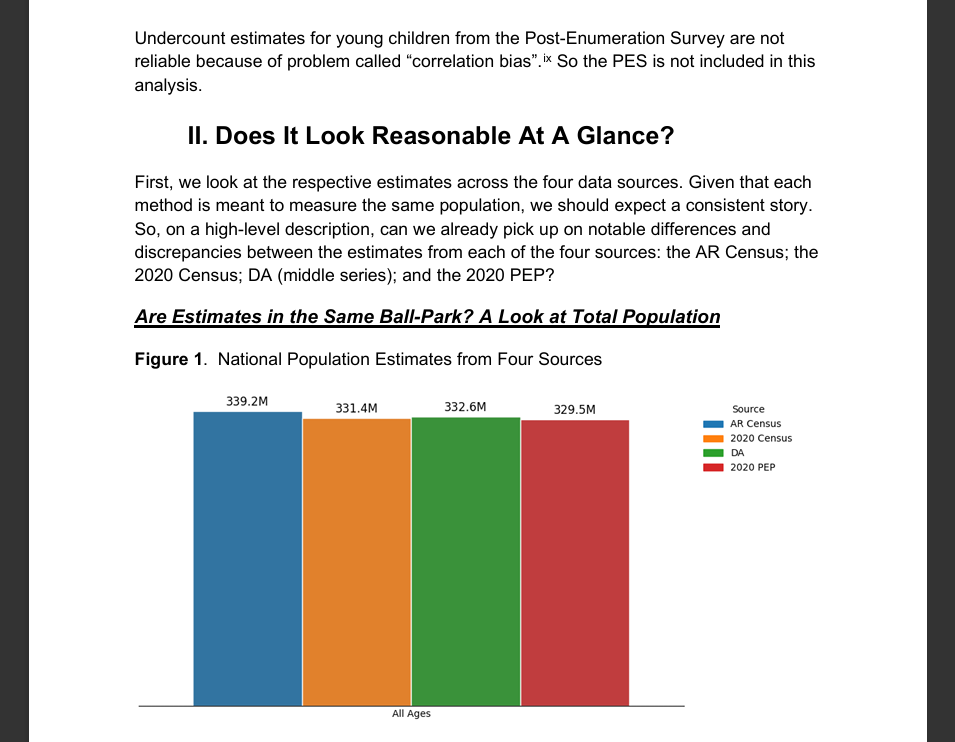
Figure 1. National Population Estimates from Four Sources

We see that the estimates across the four sources are more or less within the same ball-park. In Figure 1 above, we see the national-level estimates for the entire population (i.e. all ages) from each of the four sources. The estimates range from 329.5 million to 339.2 million.
The DA and 2020 Census estimates are fairly close. The AR Census estimate is around 2 percent higher than the 2020 Census. The authors of the AR Census study suggest that this discrepancy reflects an actual undercount in the 2020 Census and, in particular, an undercount of non-U.S. citizens. Consequently, we may have reason to believe that the AR Census may, in fact, provide a more accurate reflection when considering the total count of people in the country.
In short, the AR Census estimate for the total population counts is in the same ball-park as other sources. Any discrepancies seem to have a reasonable explanation.
Are Estimates in the Same Ball-Park? A Look at Ages 0 to 5
Figure 2. National Estimates for Young Children, Ages 0 to 5

In Figure 2 above, we see the national-level estimates for young children (ages 0 to 5) from each of the four sources. (The most granular level of data provided are for age groups 0 to 2 and 3 to 5.) This figure clearly shows that the 2020 Census undercounted the population when compared to the other sources of data. The estimate from AR Census is very similar to the estimates from DA and 2020PEP, and all three are above the 2020 Census count of young children.
We ask whether the AR Census estimates still appear similar to DA and 2020PEP when we zoom in closer into a more granular age breakdown. Figure 3 shows two age cohorts: ages 0 to 2, and ages 3 to 5.
Figure 3. National Estimates for Young Children, Ages 0 to 2 and 3 to 5

For both age cohorts (ages 0 to 2 and 3 to 5), the AR Census estimates respectively are—again—very similar to the DA and PEP estimates. However, we should expect to see slight inflation in the AR Census results, since the AR Census includes more people in total across all ages than any of the other sources. (About 6 to 9 million more people overall, depending on the comparison source.) We see a slight inflation for the AR Census estimate for 3 to 5. However, the AR Census estimate is nearly identical to DA and 2020 PEP results. Consequently, this leads us to our next question. Even if the AR Census estimate is very similar to the DA and 2020 PEP estimates in terms of absolute counts, does the AR Census have a smaller share of young children comparative to the total population?
Are Estimates in the Same Ball-Park? A Look at Ages 0 to 5 as a Share of Total Population
Given the AR Census includes noticeably more people than the other sources, we may also examine the share of young children with respect to the total population. This analysis is shown in Figures 4 and 5 below.
Figure 4. Young Children as a Share of Total Population by Benchmark, Ages 0 to 5

Figure 4 shows the population of young children (ages zero to five) as a share of the total population in each respective source. We see that the percentages are roughly equal across the AR Census, DA, and 2020 PEP. The shares are all between 7.0 and 7.1 percent compared to 6.8 percent for the Census count. Figure 5 shows a more detailed breakdown by ages zero to two and three to five. The same pattern largely holds, i.e. we see that the percentages are roughly equal across sources.
Figure 5. Young Children as a Share of Total Population by Benchmark, Ages 0 to 2 and 3 to 5

Overall, the AR estimates for young children seem reasonable, passing the “sniff” test. Given the well-studied undercount of young children in the 2020 Census, we should expect the AR Census estimate to be higher than the 2020 Census. Moreover, the AR Census estimates have a high degree of alignment with DA and PEP.
Do Estimates Tell Similar Stories About a Census Over- or Undercount?
What does a comparison between the different sources tell us with regard to the coverage of young children? Figure 6 shows net undercount and net overcount estimates based on multiple sources of data.
Figure 6. Percent Undercount of Young Children, Ages 0 to 5

Figure 6 shows the net undercount rates for young children in the census when benchmarked against the AR Census, DA, and 2020 PEP. As expected, all sources point to a high net undercount in the census for young children, ages 0 to 5. The magnitude of the undercount differs a little: the AR Census points to the largest undercount (5.8) and the 2020 PEP with the smallest (4.2 percent). All of these net undercount rate estimates are higher than net undercount rate estimates for any other age group in the 2020 Census
However, we can talk about not only the magnitude of the discrepancies between the measurements (which we looked at in the prior subsection), but we can also look at the consistency of the discrepancies between the measurements. For our purposes, what are we are particularly interested in when DA and PEP trend together but the AR Census diverges. To do this, we can compare the two age cohorts, 0 to 2 and 3 to 5. This is shown in Figure 7 below.
As shown in Figure 7, we see a diverging pattern as one moves from the data for age 0 to 2 to the age group 3 to 5. For DA and PEP, we see a declining undercount pattern. The magnitude of undercount decreases from 0 to 2 moving to 3 to 5. In fact, the undercount based on DA net undercount estimates is reduced nearly by half when moving from 0 to 2 toward 3 to 5, i.e. from 6.8 percent to 3.5 percent. In contrast, the AR Census shows that the undercount flatlines, remaining consistently just below 6 percent.
Figure 7. Percent Undercount of Young Children, Ages 0 to 2 and 3 to 5

Possible explanations for this include the timing of when young children enter some form of administrative records and how widespread is the inclusion of young children in administrative records systems. For example, newborns may not yet be in tax or program files and not all families with babies participate in programs or benefits, resulting in fewer administrative records. Census Bureau studies have documented that administrative record coverage varies substantially by age. In the 2010 Census Match Study, 11.1% of children ages 0 to 2 were not found in administrative records, compared to just 4.3% of children ages 3 to 17—demonstrating significantly lower coverage for the youngest children.[x] By the time children reach ages 3-5, we can presume that they are more likely to appear in records (e.g. as dependents on tax returns, enrolled in preschool programs, or covered by Medicaid)—consequently improving coverage. We might call this the “progressive coverage” hypothesis.
III. Taking A Closer Look at Age Cohorts 0 to 2 and 3 to 5 by Sex and Ethnicity
The story in Section II suggests that the AR Census appears to produce reliable estimates for young children, if not outperforming DA and PEP on total population coverage. But breaking down estimates by race, ethnicity, and sex reveals a different picture. Figure 8 shows the maximum disagreement between any two sources for each demographic subgroup of young children. We can call this the “swing” between sources.
Figure 8. Where Is The Greatest Disagreement Between Coverage Estimates?

Note: Estimates for Black alone male or Black alone female young children are not available for the 2020 PEP. These comparisons rely only on AR Census and DA.
For the general U.S. population, the three methods align closely. Swings stay small, just 1-4 percentage points, indicating strong consensus. This supports our intuitions discussed in Section II. However, for Black and Hispanic children, the agreement collapses. We see very large swings, with Black males ages 3 to 5 showing the largest divergence at 22.6 percentage points. In other words, we might say that AR Census’s apparent validity at the aggregate level masks fundamental measurement failures for the populations most at risk of undercounting.
To put a finer point on the argument, we can briefly discuss some of the underlying numbers. For Black children, AR Census reports far larger census undercount than DA does—36.9% versus 14.3% for Black males ages 3 to 5. For Hispanic children, the opposite occurs. AR Census shows no undercount at all for Hispanic males ages 0 to 2 while DA and PEP both show roughly 10 to 11 percent undercounts. For Hispanic children ages 3 to 5, AR Census even indicates census overcounts while DA and PEP continue to show undercounts.
These measurement failures matter because they occur precisely where accurate validation is most needed—that is, for populations historically undercounted in the census. Administrative records appear to have systematic coverage gaps or classification mismatches that vary by race and ethnicity, undermining AR Census’s reliability as an independent validator or primary source of household characteristics.
Conclusion/Looking Forward
In preparation for the 2030 Census, the Bureau is pursuing multiple strategies to improve the count of young children. Since 2022, the Census Bureau’s Undercount of Young Children Working Group has launched targeted projects and is reviewing 2020 operations, including to what extent administrative records may have helped coverage of young children during non-response follow up. That evidence base will directly shape the 2030 Census design.
This blog shows in general, administrative records reflect total population counts—and even counts for the total population under age 6, quite well. This is, the AR data is consistent with other benchmarks. However, data from administrative data is often inconsistent and/or puzzling concerning counts of young children by age, sex, race, and ethnicity. This is an area of concern if AR data is going to be widely used in the 2030 Census.
[i] Fernandez, Leticia, Rachel Shattuck, and James Noon. “The Use of Administrative Records and the American Community Survey to Study the Characteristics of Undercounted Young Children in the 2010 Census.” Census Bureau, May 2018. Available at https://www.census.gov/content/dam/Census/library/working-papers/2018/adrm/carra-wp-2018-05.pdf; Lee, Jae June, and William O’Hare. “Census Accuracy: Five Key Results & Trends Explained.” Georgetown Center on Poverty and Inequality, November 2024. Available at https://www.georgetownpoverty.org/wp-content/uploads/2024/11/Census-Accuracy-Five-Key-Results-and-Trends-Explained-Nov2024.pdf.
[ii] Census Bureau. “Census Bureau Releases Experimental Estimates of State and County Undercounts and Overcounts of Young Children in the 2020 Census.” April 2024. Available at https://www.census.gov/newsroom/press-releases/2024/undercounts-overcounts-children-2020-census.html.
[iii] Census Bureau. “2030 Census Research Project Explorer.” Available at https://www.census.gov/data/data-tools/decennial/2030-census-research-explorer/.
[iv] O’Hare, Bill. “How Well Would Administrative Records Correct the Undercount of Young Children in
the U.S. Census?” June 2023. Available at https://countallkids.org/resources/how-well-would-administrative-records-correct-the-undercount-of-young-children-in-the-u-s-census/.

[v] Lee, Jae June, and William O’Hare. “Census Accuracy: Key Methods Explained.” Georgetown Center on Poverty and Inequality, November 2024. Available at https://www.georgetownpoverty.org/wp-content/uploads/2024/11/Census-Accuracy-Five-Key-Results-and-Trends-Explained-Nov2024.pdf.
[vi] Jensen, Eric, et. al. “Methodology for the 2020 Demographic Analysis Estimates.” U.S. Census Bureau, 15 December 2020. Available at https://www2.census.gov/programs-surveys/popest/technical-documentation/methodology/2020da_methodology.pdf
[vii] Brown, J. David, et al. “Real-Time 2020 Administrative Record Census Simulation.” Census Bureau, May 05, 2023. Available at https://www.census.gov/programs-surveys/decennial-census/decade/2020/planning-management/evaluate/eae/2020-admin-record-census-simulation.html.
[viii] Brown, J. David, et al. “Real-Time 2020 Administrative Record Census Simulation.” Census Bureau, May 05, 2023. Available at https://www.census.gov/programs-surveys/decennial-census/decade/2020/planning-management/evaluate/eae/2020-admin-record-census-simulation.html.
[ix] O’Hare, W. P., Robinson, J.G., West, K., and Mule, T., (2016). “Comparing the U.S. Decennial Census Coverage Estimates for Children from the Demographic Analysis and Coverage Measurement Surveys,” Population Research and Policy Review, Vol. 35, Issue 5, pages 685-704.
[x] Rastogi, Sonya and Amy O’Hara. Census Match Study.Census Bureau, 2012; Rastogi, Sonya, et al. “Exploring Administrative Records Use for Race and Hispanic Origin Item Non-Response. Working Paper.” Census Bureau, 2018.