

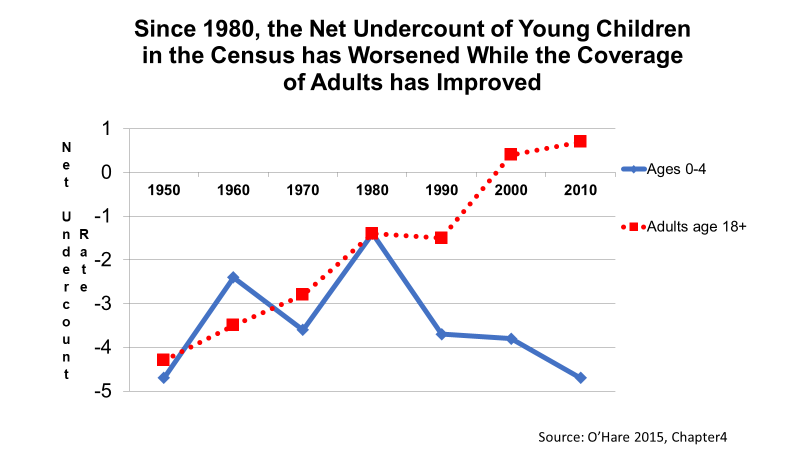
Since 1980, the net undercount for young children has increased while the census count of adults has improved.
The graph below shows the net undercount rates of young children in blue and the net undercounts/overcounts of adults in red. In the 1980 Census, both groups had an undercount rate of about 1.5 percent. Since 1980, the net undercount rate of young children has tripled, while the census coverage of adults has improved to the point that there were small net overcounts in 2000 and 2010.
The net undercount of young children is not only a big problem, it is a growing problem. Unless we do something different in the 2020 Census than we have done in the last couple of censuses, we should expect the net undercount of young children to increase.
____
Dr. William O’Hare has more than 40 years of experience as an applied demographer and expert data analyst. For fifteen years prior to his retirement, he ran the KIDS COUNT project at the Annie E. Casey Foundation. He is the author of the book, The Undercount of Young Children in the U.S. Decennial Census, published in 2015. He holds a PhD from Michigan State University.